Stand at the gable of an old thatched house in the midlands and you are looking at a roof that was, for most of its history, grown rather than bought. The straw came off the farm after the harvest. The sod underneath was cut from rough ground or the edge of the bog. The pins that hold it all down were hazel or sally rods from the nearest ditch. Very little arrived on a lorry. A thatched roof was, quite literally, a piece of the surrounding fields lifted up and laid over the family’s heads.
That idea is worth holding on to, because it explains almost everything about Irish thatch: why it looks different in Donegal and Wexford, why the materials have changed, and why people who care about old buildings get so particular about doing it “the right way”.
A roof from whatever the land gave
The Department of Housing’s guide Caring for Our Vernacular Heritage describes how traditional houses were built from what lay close to hand: “scraws from the bog or grassy sward, straw from the harvest, reed from rivers and lakes, and more besides.” Writing in the Heritage Council’s Heritage Outlook in 2006, the vernacular architecture specialist Fidelma Mullane noted that wheaten, oaten and rye straws were the traditional materials for the most common style, with reed used where it was plentiful. Along the Atlantic coast, roofs were also made of flax, rushes or wild grasses.
A National Inventory of Architectural Heritage report on the protection of thatched structures goes further, sorting old Irish thatch into rough social bands. At the bottom was “scavenger” thatch on the poorest houses, made from heather, broom, bracken or marram grass. The great majority of houses carried “vernacular” thatch of locally grown wheat, oats, rye or even barley. And then there was “landlord” thatch: the consciously picturesque roofs of gate lodges and estate cottages, often borrowing English decorative styles. The report points out that this last strand is the ancestor of much of today’s reed thatching.
The scraw: a layer of sod under the straw
Under many Irish thatched roofs lies something most visitors never see: the scraw, a layer of sod. Mullane describes how it was taken from poor land where the grass was “tough and wiry with matted roots”, then laid on the roof timbers grass side up, in long strips or squares. The government guide describes it being rolled onto the roof in strips about 30 cm wide, running the full height of the roof and a bit more so that it overlaps the ridge, and tied to the timbers with rope. It gives the thatcher something solid to pin into, and it adds another layer between the weather and the kitchen below.
Three great styles
In 1945 the folklorist Kevin Danaher sent out a postal questionnaire on roofs and thatching through the Irish Folklore Commission. From the replies he mapped the main methods used on dwellings across the country.
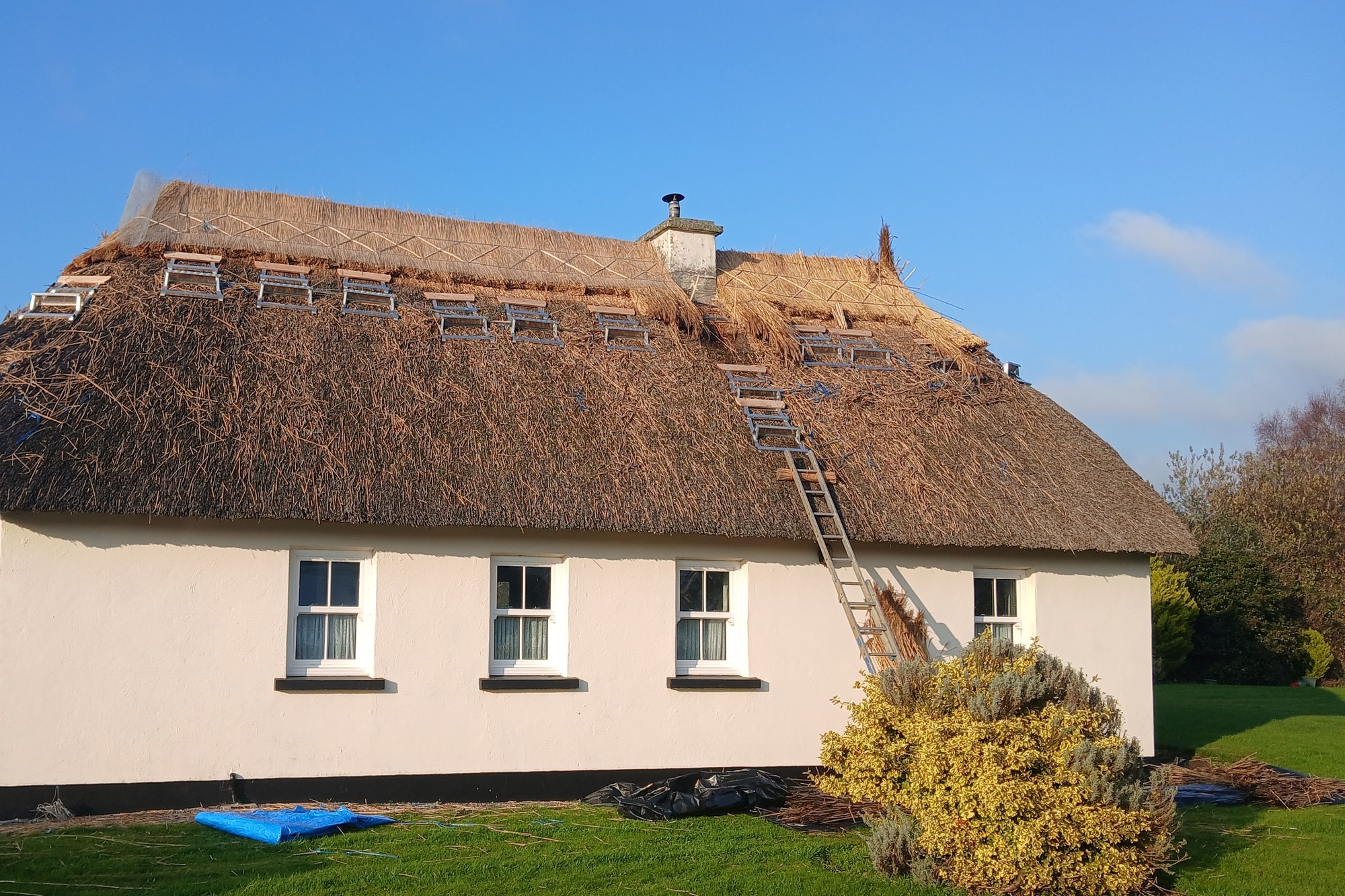
Scollop or pinned thatch is the most widespread, with examples recorded in almost every county and covering roughly the western two-thirds of the island, the midlands included. The thatcher works in strips from eaves to ridge, roughly 50 to 60 cm wide depending on the source. Each layer of straw is held down by a “stretcher” (a hazel or sally rod laid across the bundles), which is pinned in place with scollops: hairpin-shaped rods pushed in and upwards through the straw. The next bundles overlap and hide the fixings, which is why it is sometimes called hidden scollop thatch. Mullane’s article includes a photograph of scollop thatching in straw on a hip-roofed house in Co. Offaly.
Thrust thatch belongs to the drier, less windy east, mainly Leinster and parts of east Ulster. Here there is usually no sod. The first layer of straw is sewn to the roof timbers with a thatching needle. After that, handfuls of straw knotted at one end are pushed into the existing thatch with a small two-pronged fork, known as a spurtle or beating pin. The straw is often dampened and beaten down to give a smooth slope, and scollops and stretchers are used only at the eaves and ridge.
Roped thatch was once the most common style on the west coast from Kerry to Donegal. The thatch is laid over the scraw and held down by a net of súgán (straw or other natural-fibre ropes) crossing the roof, with the ends tied to stones, pegs or iron fixings at the eaves and gables. Mullane notes that by 2006 it had almost disappeared from dwellings but survived on byres, hen houses and turf sheds in Connemara, usually thatched by farmers rather than professional thatchers. There are variants too, such as pegged thatch in north Antrim, Derry and parts of Connemara, and the nearly vanished stapple thatch of the Lecale peninsula in Co. Down.
The ridge: the thatcher’s signature
The ridge is where a thatcher’s own hand shows most. In many areas, according to Ask About Ireland’s account of thatching methods, the ridge is finished with rows of “bobbins”: wisps of straw shaped around a rod laid along the ridge, with the free ends pinned down either side with scollops. Mullane observed that many thatchers develop their own “ridge signature” with decorative lattice patterns, so a practised eye can sometimes tell who did a roof.
Why thatch is warm in winter
Anyone who has sat in a thatched kitchen on a raw November evening knows the difference. A deep coat of straw or reed, often on top of a sod layer, is a thick blanket of trapped air. Mullane called it an “efficient insulator”, recalling how the old thatched pub needed no coolers on its taps: the pint stayed cool in summer and warm in winter. For new work, the Department’s thatching grant rules require a fully renewed roof to have at least 350 mm of new thatch.
Upkeep: a roof that is never quite finished
Thatch is a living roof, and it needs minding. According to Mullane, a thrust or scollop roof can last between ten and twenty years, with the ridge renewed about every five; roped thatch was often redone every year or two. The government guide says the ridge and the areas around chimneys need renewing every few years, and the whole roof may need a new coat perhaps every ten years, depending on the material.
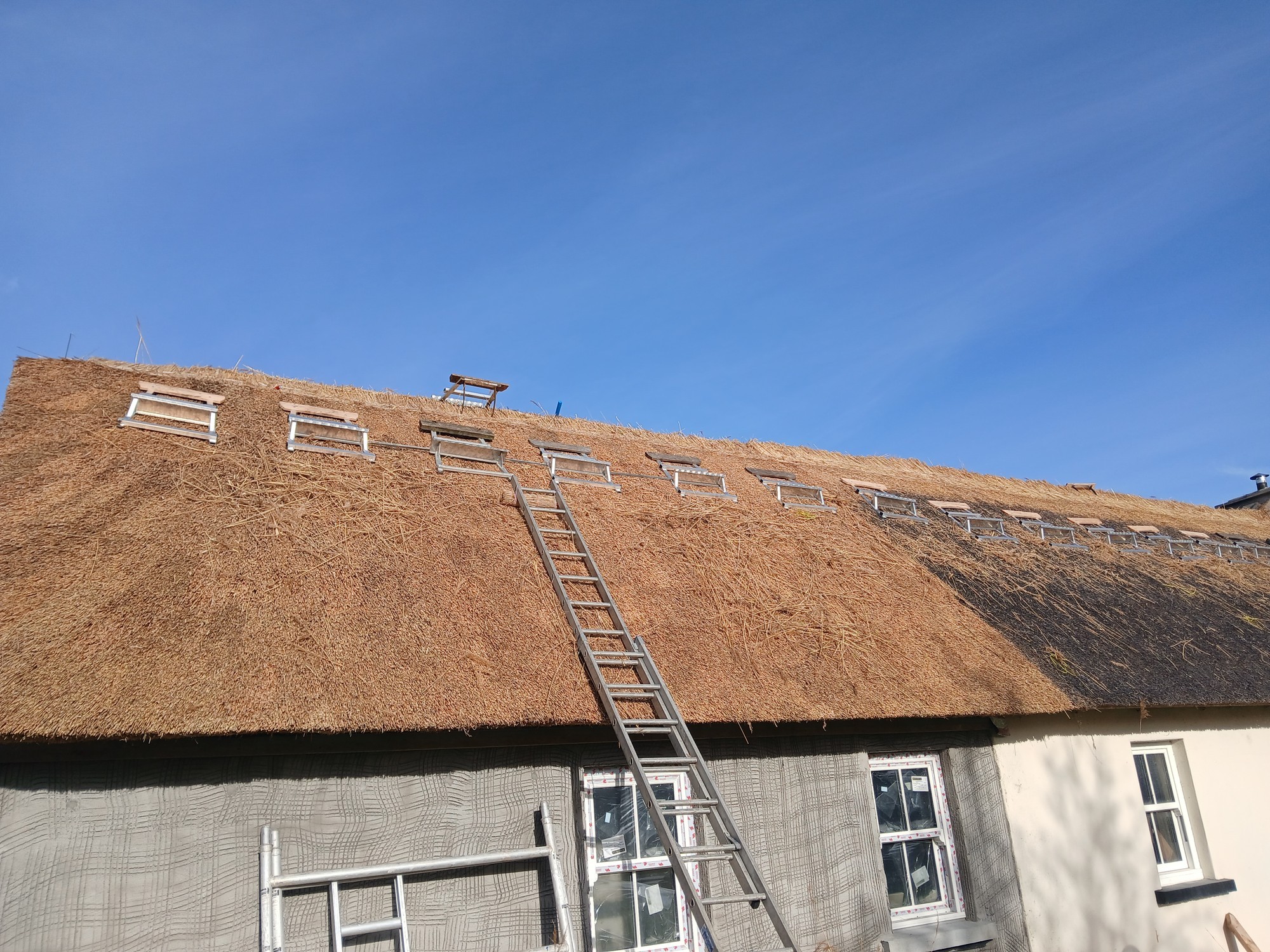
The material itself has changed. As traditional cereal growing declined, good thatching straw became hard to find. Mullane traced a shift from straw to Irish reed in the 1970s and 1980s and then, from the 1990s, to imported reed. Conservation bodies worry that this can wear away the local character of a building, which is why heritage grants usually ask for the same material and style as was traditionally used, and for as much of the old thatch as possible to be kept.
Help with the cost
Two State schemes help owners. The Department of Housing, Local Government and Heritage’s Thatching Grant may pay up to €3,810, or two-thirds of the approved cost, whichever is less, towards renewing or repairing the thatched roof of a house that is the owner’s normal home. Higher amounts apply on specified islands and for Medical Card holders, and work must not start before a Department inspection. Separately, the Historic Thatched Buildings stream of the Built Heritage Investment Scheme, run through local authorities, can offer up to €20,000 for historic thatched structures, including commercial ones. Details, dates and conditions change, so check the gov.ie pages and your county council before planning any work.
Sources and further reading
- Department of Housing, Local Government and Heritage, Caring for Our Vernacular Heritage: https://www.buildingsofireland.ie/app/uploads/2021/12/Caring-for-Our-Vernacular-Heritage.pdf
- Fidelma Mullane, “Thatching in Ireland: the role of thatch in vernacular architecture”, Heritage Outlook, Summer 2006, The Heritage Council: https://www.heritagecouncil.ie/content/files/heritage_outlook_summer_2006_2mb.pdf
- Report on the Present and Future Protection of Thatched Structures in Ireland, Vol. 2: https://www.buildingsofireland.ie/app/uploads/2019/10/Report-on-the-Present-and-Future-Protection-of-Thatched-Structures-in-Ireland-Volume-2-Supporting-Information.pdf
- Ask About Ireland, “Methods of Thatching”: https://www.askaboutireland.ie/reading-room/history-heritage/architecture/the-thatched-house-of-co/methods-of-thatching/
- gov.ie, Thatching Grant: https://www.gov.ie/en/department-of-housing-local-government-and-heritage/services/thatching-grant/
- gov.ie, Historic Thatch Grant: https://www.gov.ie/en/department-of-housing-local-government-and-heritage/services/historic-thatch-grant/
If you would like to see water reed thatching done by hand, or try it yourself, the Boglands thatching pages at https://thatch.boglands.ie are a good place to start.
Do you live under thatch, or remember a thatcher at work in your own townland? We would love to hear from you. Send us your poetry, prose, short stories or photographs through our Submit Your Work page.