In summer the bog is busy. There are skylarks, bog cotton nodding in the wind, families out on the bank with slanes and barrows, the smell of cut turf drying in the sun.
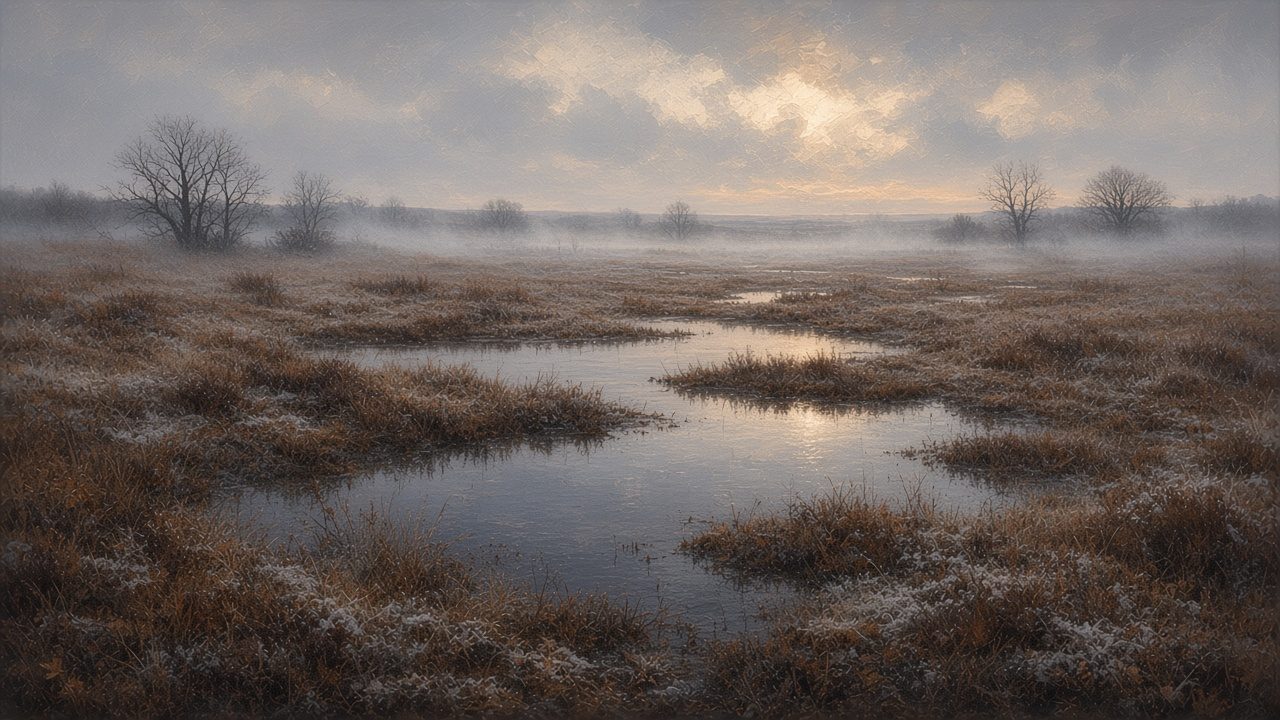
By November all that is over. The turf is home, or should be. The days are short, and the light comes in low and sideways across the heather. People tend to stay away from the bog in winter, and that’s a pity, because this is when you see what a bog really is.
A landscape made of water
Ask most people what a bog is made of and they’ll say “turf”. The truer answer is water.
The Irish Peatland Conservation Council (IPCC) explains that a raised bog, the great domed bog of the midlands, “may be up to 98% water and only 2% solid matter”. The water is held in the dead remains of Sphagnum moss, layer on layer, built up over a very long time. Raised bogs began to form about 10,000 years ago, in hollows filled by shallow lakes. In places the peat is up to 12 metres deep.
A healthy raised bog lives on rain alone. Its water table stays, as the IPCC puts it, “within a few centimetres of the bog’s surface about 95% of the time”. On top sits a thin living skin, the acrotelm, usually less than half a metre deep, of living moss and freshly dead plants. Below that is the catotelm: the “chocolate-coloured” mass of old peat, permanently soaked, where most of the water is stored.
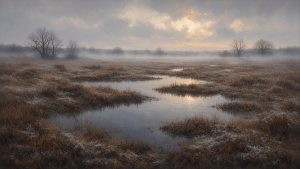
In winter, when the rain comes in off the Atlantic for days on end, the bog does what it was made to do. It soaks it up, holds it, and lets it go slowly. The pools fill, the hollows shine, and the whole dome seems to swell.
The bog goose
Once, the winter bog had visitors from the far north.
The Greenland white-fronted goose, which breeds in west Greenland, was traditionally known in Ireland as the “bog goose”. The National Parks and Wildlife Service, which runs the Wexford Wildfowl Reserve, explains that the birds “fed in upland and blanket bog areas rich in nutritious plants such as White-beaked Sedge and Bog Cotton”. They arrive in Ireland and Scotland around October, after a journey of about 3,000 km via Iceland, and leave again in spring.
As bogs were drained and cut, the geese moved to marshes and wet grasslands. Today most of them winter on the farmland of the Wexford Slobs. The latest figures quoted by the reserve show 7,800 birds wintering in Ireland in 2023. Smaller flocks of up to several hundred birds still turn up in counties Donegal, Roscommon, Westmeath and Offaly.
The world population has fallen sharply since its peak of 35,500 birds in 1999, to roughly 18,000 now, linked mainly to poor breeding success in Greenland. If you’re lucky enough to hear a skein of white-fronts calling over the midlands on a winter evening, stop and listen.
Turf at home
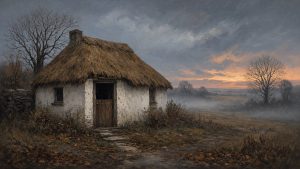
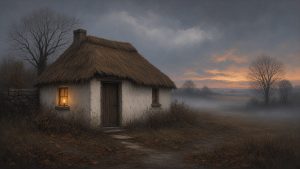
For generations, the bog’s winter role was to keep the house warm. Turf cut in spring, footed and dried over the summer, and drawn home in autumn was stacked by the gable or in the shed, ready for the long nights.
That still happens. The rules have changed in recent years, though. Under the solid fuel regulations that came into force on 31 October 2022, people with turbary rights can still cut turf for their own use, and can gift or sell it to others. What they can’t do is sell it “by way of the internet or other media, or from a retail premises”, which includes shops, garages, fuel yards and pubs. The Minister set this out in answer to a Dáil question in November 2022.
Whatever your view, the smell of a turf fire on a cold evening is still one of the great smells of rural Ireland.
The big bogs fall quiet
The biggest change of all came on the industrial bogs. In January 2021, Bord na Móna formally ended all peat harvesting on its lands. Its last full harvest had been in 2018. Under its Peatlands Climate Action Scheme, the company is rewetting and rehabilitating around 33,000 hectares across more than 80 bogs. The aim is to raise the water levels and create “soggy peatland conditions” in which bog plants, wetland and woodland can return.
So on the old production bogs, winter now means water coming back. Drains are blocked, pools are forming, and over time Sphagnum has a chance to grow again.
A habitat under pressure
It’s worth knowing how precious the remaining bogs are. The IPCC calls Ireland’s raised bogs “the finest example of their type in Europe, and probably the world”. They’re also a store of carbon and water, and a record of past climates and human life.
They’re in trouble, though. In the most recent report to the EU under the Habitats Directive, in 2025, Ireland’s active raised bog was given a “bad” conservation status, although with an improving trend. The IPCC estimates that only about 10% of the original raised bog area remains suitable for conservation.
Walking the winter bog
If you’d like to see a bog in winter, choose a place with a path or boardwalk. Public raised-bog walks, such as the boardwalk at Clara Bog in Co. Offaly, let you see the pools and mosses without damaging them, or yourself.
A few sensible rules:
- Stay on the path. Bog pools and drains can be deep, and the surface can be softer than it looks.
- Go in daylight. In midwinter the light goes early.
- Wear wellies and warm, waterproof layers. The wind has nothing to stop it out there.
- Leave it as you found it. Don’t trample the mosses or take plants.
Then stand still for a minute and listen. There may be a snipe getting up from the heather, the far-off honk of geese, or just the wind and the water. After a summer of noise, the bog in winter is the quietest place in the country.
Bog Magazine is a sister site of Boglands, home of our craft and heritage workshops.
Have you photographs of the bog in winter, or memories of the turf and the long nights? Bog Magazine welcomes writing and photographs rooted in rural Ireland. Send us your work.
Sources
- Irish Peatland Conservation Council, “Raised Bogs”: https://www.ipcc.ie/a-to-z-peatlands/peatland-habitat-types/raised-bogs/
- Wexford Wildfowl Reserve (National Parks and Wildlife Service), “Greenland White-fronted Goose”: https://www.wexfordwildfowlreserve.ie/wildlife-2/greenland-goose/
- Houses of the Oireachtas, Parliamentary Question, “Turbary Rights”, 22 November 2022: https://www.oireachtas.ie/en/debates/question/2022-11-22/185/
- S.I. No. 529/2022, Air Pollution Act 1987 (Solid Fuels) Regulations 2022: https://www.irishstatutebook.ie/eli/2022/si/529/
- Bord na Móna, “Bord na Móna announce formal end to all peat harvesting on its lands”: https://www.bnm.ie/bord-na-mona-announce-formal-end-to-all-peat-harvesting-on-its-lands/
- RTÉ News, “Bord na Móna formally ends peat harvesting operations”, 15 January 2021: https://www.rte.ie/news/business/2021/0115/1189899-bord-na-mona-peat-operations/
- Bord na Móna, Peatlands Climate Action Scheme: https://www.bnmpcas.ie/
- National Parks and Wildlife Service, Article 17 Reports 2025 (status of EU-protected habitats in Ireland): https://www.npws.ie/publications/article-17-reports/article-17-reports-2025