Ní imithe uainn atá siad, ach imithe romhainn.
They are not gone from us, but gone before us.
There’s an old Irish saying, quoted by the Irish Catholic Bishops’ Conference in its November reflections, that sums up how rural Ireland has long felt about its dead. They’re not lost, just gone on ahead. And for one month of the year, they’re given particular attention.
November, in the Irish calendar, is the month of the holy souls.
Two days at the start of the month
The month opens with two feasts. All Saints’ Day, on 1 November, honours all the saints. The next day, 2 November, is All Souls’ Day, which the Church calls “the Commemoration of the Faithful Departed”: a day for remembering everyone who has died.
They sit right on top of the old Celtic festival of Samhain. As the National Museum of Ireland records, Halloween was known as “ghost night” or “spirit night”, when “the souls of the dead were expected to return to the family home”. All Souls’ Day followed close behind. The old belief and the Christian feast lie so close together that it’s hard to say where one ends and the other begins.
The November dead list
In many Irish parish churches at the end of October, you’ll find envelopes in the porch. These are for the November dead list: families write down the names of their dead and return the envelope to the church.
Doora-Barefield parish in Co. Clare describes the custom in its notice for this year: during November, “Mass will be offered each day for all on our November Dead List of the parish”, with envelopes “now available in the porches of our churches” and lists to be returned by All Souls’ Day. Some parishes call it the “Altar List of the Dead”. The names are remembered at Mass right through the month.
For many families it’s one of the small, steady rituals of the year: sitting at the kitchen table, pen in hand, going through the names of parents, grandparents, neighbours and friends. The list tends to get longer as the years go on.
Blessing the graves
November is also a month for visiting the graveyard. The Bishops’ Conference notes that parishes mark the month “with events like the blessing of the graves, the celebration of remembrance services”, and many churches set up a sacred space for the whole month: a remembrance tree, a book of remembrance or a remembrance candle.
At a grave blessing, the priest moves through the graveyard with holy water, and families gather at their own plots. It’s a sociable occasion as much as a solemn one. People meet neighbours they haven’t seen in months, beside the graves of people they knew.
The dead come home
Older customs ran deeper. In folklore collected from schoolchildren across Ireland in the 1930s for the Schools’ Collection, now held by the National Folklore Collection, you’ll find accounts of how households prepared for the dead on the night of All Souls.
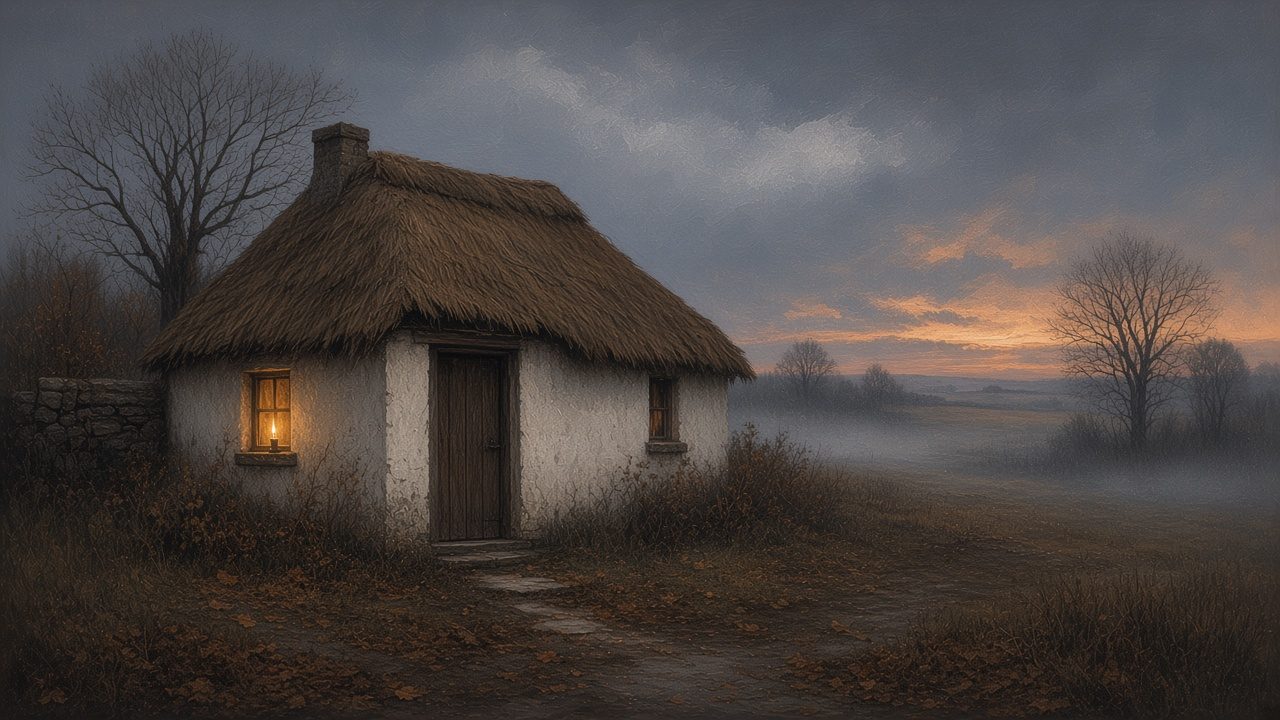
A pupil at the convent school in Carndonagh, Co. Donegal, wrote that on All Souls’ Night “the house is made tidy. Chairs are set in front of the fire, the lamp is left lighted, bread and water is left on the table and the door is left on the latch for the souls who are believed to come to the houses.”
Another entry, from Cill Condae, describes candles lit “on all the windows to guide the souls on their way”, the door left open, “a fine fire” put on the hearth, a bucket of fresh spring water and plenty of food set out in the kitchen, “in order that the souls may find warmth and comfort in their old homes.” Nobody went out that night, for fear of meeting the dead on the way, as it was counted unlucky. The details vary from parish to parish, and in many places the same welcome was laid out on Halloween night itself.
Whatever the variation, the idea was the same: the dead were family, and family is welcomed home.
The wake
The month of the holy souls is also a good time to remember how rural Ireland once said goodbye.
As Marion McGarry writes for RTÉ Brainstorm, the traditional wake lasted for three days before burial, and the corpse was never left alone. Mourners sat up through the night. The keeners, professional mourners, performed a lament that praised the dead, grieved for them and even scolded them for dying. The Catholic Church was hostile to keening, McGarry notes, and the tradition “had largely died out by the beginning of the 20th century”.
Visitors to the wake house were handed clay pipes filled with tobacco. They took a pull and said, “Lord have mercy on their soul.” After the funeral the pipes were broken and buried. Through the night came the “wake amusements”: stories (often funny ones about the dead person), tongue-twisters, feats of strength, tricks and games. They might sound strange now, but as McGarry puts it, “the overriding mood at a wake was of reverence for the dead”. The merriment was set aside if the dead person was a young parent or a child, or had died in tragic circumstances.
Much of that has gone. The keeners are a memory, and the clay pipes have long since disappeared. But much remains: the house full of neighbours, the tea and sandwiches (or these days a meal in the local hotel), the stories and the laughter, the long queue of mourners waiting to shake hands with the family and say, “Sorry for your trouble.”
Keeping the light
Now, in the dark weeks after Halloween, the November customs carry on, quietly. A name on a list. A candle lit. A stop at the graveyard on the way home from Mass. A story told about someone who’s no longer at the table.
Ní imithe uainn atá siad, ach imithe romhainn. It is a gentle way to spend the darkest month of the year.
Have you written about someone you’ve lost, or about the November customs in your own parish? Bog Magazine welcomes poetry, prose, short stories and photographs rooted in rural Ireland. Send us your work.
Sources
- Irish Catholic Bishops’ Conference, “In November We Remember”, 30 October 2019: https://www.catholicbishops.ie/2019/10/30/in-november-we-remember/
- National Museum of Ireland, “Ghost turnips, the púca, fortune-telling and evil abductions…” (Clodagh Doyle): https://www.museum.ie/en-IE/News/2023/Ghost-turnips,-pucas,-fortune-telling-and-evil-abd
- Doora-Barefield Parish, “November Masses for the Holy Souls”, 13 October 2026: https://www.doorabarefieldparish.ie/november-masses-for-the-holy-souls/
- Monkstown Parish, “November Altar List of the Dead”: https://monkstownparish.ie/november-altar-list-of-the-dead/
- Marion McGarry, “How the rituals around Irish deaths, wakes and funerals have changed”, RTÉ Brainstorm, 18 January 2023: https://www.rte.ie/brainstorm/2023/0118/1346067-ireland-death-rituals-funerals-wakes/
- dúchas.ie, The Schools’ Collection, Clochar na Trócaire, Carn Domhnaigh (Carndonagh, Co. Donegal), “All Souls Night”: https://www.duchas.ie/en/cbes/4493771/4418746
- dúchas.ie, The Schools’ Collection, Cill Condae, “Folklore”: https://www.duchas.ie/en/cbes/4921924/4900673/4933635