By the middle of November the year’s heavy work is done. The turf is home, the hay and straw are in the shed, and the evenings close in before the tea is on the table. For generations, the way all that work got done in rural Ireland came down to one word: meitheal.
Few words carry as much of country life. A meitheal was the band of neighbours who turned up on the day a big job had to be done, worked until it was finished, ate together, and moved on to the next farm when its turn came. Nobody was paid in money. The payment was that the same people would be standing in your field when you needed them.
What the word means
Ó Dónaill’s Irish dictionary gives the plain meaning first: a working party. A meitheal bhuana was a band of reapers and a meitheal mhóna a band of turf cutters. There is even a lovely phrase for a big family, tá meitheal mac aige, “he has a large family of sons to help him”.
Close beside it sits another Irish word, comhar, meaning combined work or mutual assistance. The dictionary records comhar na gcomharsan, “neighbourly co-operation”, and the idea of paying back the comhar, returning a service to someone who has helped you. That was the engine of the whole system. Around the midlands you will still hear older farmers call it “coring”. One West Offaly farmer, speaking to the DCU academic Pat Brereton, put it simply: “Coring or Meitheal as it was called was all the rage at the time.”
The word was not confined to the Irish-speaking districts. According to Ask About Ireland, it has been recorded in 22 of the 32 counties, and in every case it meant a team of more than three workers.
Threshing day
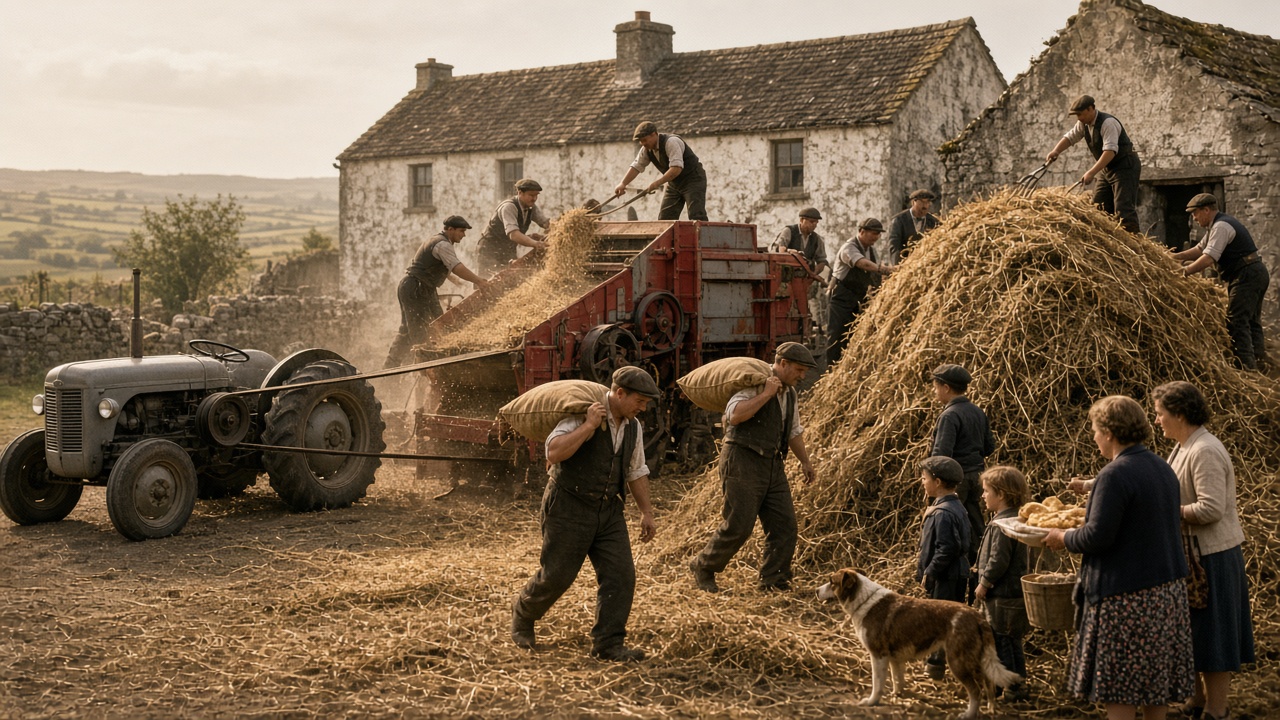
If one day stands for the meitheal in folk memory it is the threshing. When the threshing machine came up the lane, one family could never supply all the hands it needed. In Co. Leitrim, Ask About Ireland records, a meitheal of eight or ten neighbours attended the machine. One man cut the ties on the sheaves while another fed the drum; the straw came out one end and the oats ran into bags hooked on at the other, and the straw was built into a rick and roped down.
The children who wrote for the Schools’ Collection of the National Folklore Collection in the 1930s described the same scene again and again. A pupil in Tyrrellspass, Co. Westmeath, just over the Offaly border, wrote that on the day of a threshing “all the neighbours go to help”, that long ago there was a half barrel of porter for the men, handed around in mugs, and that the dinner was cooked ham.
Threshing was so much part of the landscape that it even got into the legends. A pupil at Rhode in Co. Offaly recorded a story about a stone standing in a local field: it was said to be a lump of butter that Fionn Mac Cumhaill’s sister threw from Carbury Hill to her sister-in-law on Croghan Hill, “where a threshing was going on”. Even the giants, it seems, fed their meitheal well.
Not every crowd in a haggard was a meitheal. A pupil in Kinnitty, Co. Offaly recorded that when a local landlord was threshing, people came from Killoughy to help, and anyone who was not there by six o’clock in the morning worked the day for no money. That was labour owed upward. The meitheal was something different: work traded sideways, between equals.
Turf, hay and the tea in the sock
The bog had its own meitheal. In Cappeen, Co. Cork, an 86-year-old smith named Michael Cross told a pupil that about thirty years earlier he had had “a meitheall of thirty-two men cutting turf” in the bog,.
Much of the work of a meitheal happened away from the field. Ask About Ireland notes that neighbours were never paid, but the family always fed them: brown bread, cheese, scones, tea and buttermilk carried out at midday, and a house dance once the harvest was brought home. Gertie Murphy of Kilteevan, Co. Roscommon, remembering the turf meitheal for the Tóchar Wetlands community stories, said it was “a very hard week on the housewife”, with all the baking and the men to be fed in the bog. The tea went out in naggin bottles, and the trick for keeping it hot was to slip each bottle into a man’s sock.
In the Mealagh Valley in west Cork, the local Heritage Keepers have recorded neighbours’ memories of threshing days, and one line sums up the whole arrangement: “There was no money. You came to me today, and I went to you tomorrow.”
Why it faded
The meitheal was old. The folklorist Anne O’Dowd, in her 1981 study Meitheal: a study of co-operative labour in rural Ireland, notes that references to co-operation in farm work turn up from the Brehon Laws onward. What ended it, in most places, was the machine. By the 1960s tractors had arrived, and one farmer could do with a fraction of the help his father had needed.
Pat Brereton’s recent oral history of farming in the midlands, gathered around Cloghan in West Offaly, found that older farmers mostly welcomed the big machinery, but several said it left less time for simply talking to the neighbours, and that it is now very hard to get anyone to help out on the land (RTÉ Brainstorm, July 2026). Gertie Murphy put it more bluntly: in her view, people today have everything, but not the community and the meitheal they had then.
The meitheal now
And yet the word refuses to retire. The Irish Countrywomen’s Association has run a week-long Meitheal at An Grianán in Co. Louth, where members share skills from weaving to cookery; when RTÉ visited in 1984 the director said the week “incorporates all that was best in the traditional meitheal”. Tusla, the Child and Family Agency, named its early-intervention model Meitheal, explaining that it is “an old Irish term that describes how neighbours would come together to assist in the saving of crops or other tasks”.
You can see it closer to home, too. The Tidy Towns crew out with litter pickers on a Saturday morning, the volunteers who paint the community hall, the club members who line a GAA pitch before a match, the neighbours who turn up with a trailer when a shed roof blows off in a winter storm. Nobody calls it a meitheal, but it is the same old bargain: you came to me today, and I will go to you tomorrow.
As the dark evenings settle in, it is worth asking who helped bring your own year home, and who might need a hand before winter is out. That is all a meitheal ever was.
Do you remember a threshing, a turf meitheal or a house dance after the harvest? We would love to read your own poetry, prose, short stories or photos. Send in your work here.