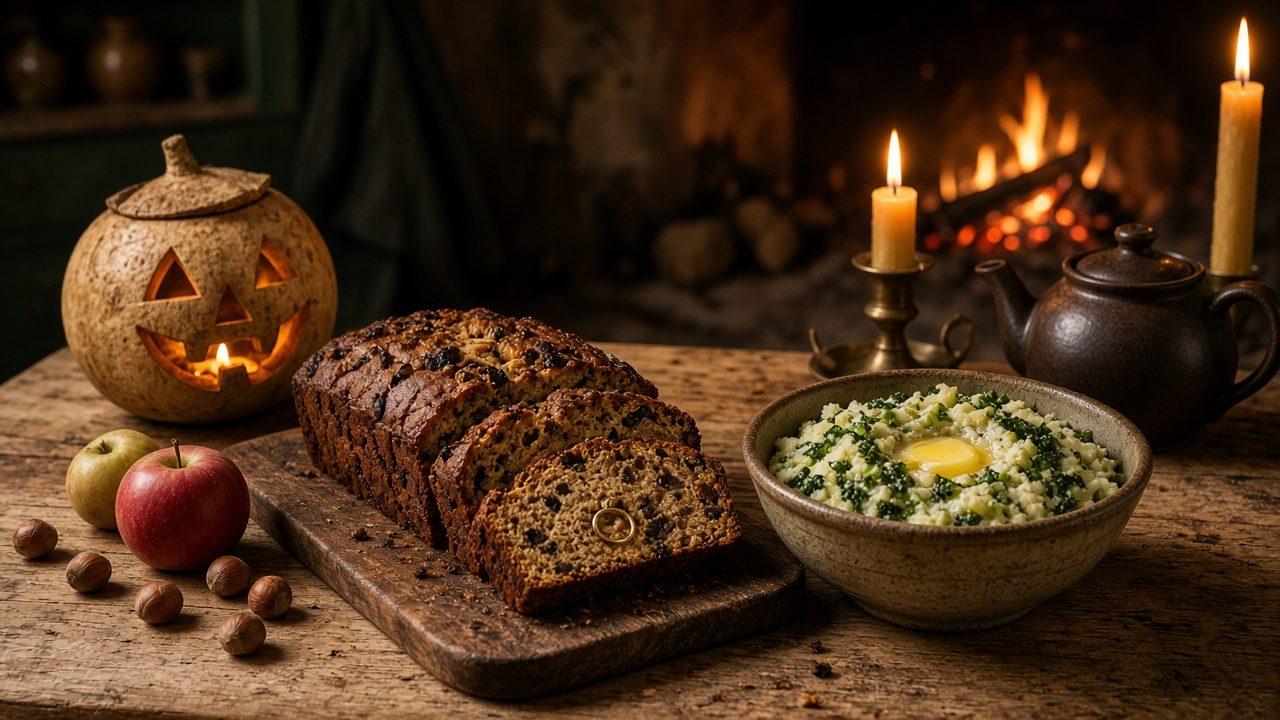
On Halloween night in rural Ireland, supper came with a side of suspense. Somewhere in the cake or in the pot was a ring, or a coin, or a rag, or a stick. Whoever found it in their portion had their future told before the plates were cleared.
Two dishes carried most of that weight: the báirín breac, or barmbrack, and colcannon. Here’s where they come from, what was hidden inside them, and how you can bring them to your own table this year.
The Halloween harvest
Samhain, the start of winter on 1 November, was always marked with food. The National Museum of Ireland notes that “traditionally a harvest of fruit and nuts was gathered for the festive fare”. Apples and nuts turned up in games as well as on the table. Bobbing for apples and “apples on a string” were common.
Alongside them, the museum lists the traditional Halloween foods: báirín breac, colcannon (“mashed potato with cabbage and onions”) and boxty (potato cakes).
Báirín breac: the speckled loaf
The barmbrack is a fruit loaf, dark and dense and heavy with dried fruit. Its Irish name, báirín breac, is usually explained as “speckled loaf”, after the fruit that freckles every slice.
The National Museum calls it “the traditional cake eaten at Halloween”, and it’s the brack that carried the best-known fortune of all. According to Clodagh Doyle, Keeper of the National Folklife Collection, a ring was baked into the cake and “whoever receives the lucky slice is destined to be the next to marry”.
The ring often had company. Doyle lists the other objects that might be hidden in the brack, each with its own prophecy:
- a ring: marriage, and soon
- a thimble: spinsterhood
- a button: bachelorhood
- a stick: a spouse who would beat you
- a rag: poverty
- a coin: wealth
- a crucifix: a life in religious orders
Not every household used every token, and the meanings varied from place to place. But you can picture the scene: a family round the table, everyone chewing slowly and carefully, and a shout when someone bit on something hard.
Today most bracks come from the shop, often with a small ring tucked inside. As Doyle puts it, “supermarkets do the barmbrack, the costumes and the treats!”
Colcannon: the Halloween pot
If the brack was the cake of Halloween, colcannon was the dinner.
It’s a humble dish: potatoes mashed with cabbage or kale, butter and milk, often with scallions (spring onions) or onions. But it’s an old one. Writing in Smithsonian magazine, Jennifer Billock quotes the diary of William Bulkely, a traveller from Wales who ate it in Dublin on Halloween night in 1735:
“…what they call there Coel Callen, which is cabbage boiled, potatoes and parsnips, all this mixed together. They eat well enough, and is a Dish always had in this Kingdom on this night.”
So nearly three centuries ago, colcannon was already “always had” on Halloween.
Dr Máirtín Mac Con Iomaire, a chef and lecturer then at the Dublin Institute of Technology, told Smithsonian that by the mid-18th century colcannon had become a staple food. It brought together the cabbage and kale of the older Irish diet with the newer potato. Like the brack, the pot could hide a fortune. He describes a coin, a rag or a stick cooked into the colcannon, with the same meanings: wealth, poverty or a violent spouse. The trinkets and their meanings, the article notes, varied from area to area.
There’s even an old song about it. “The Auld Skillet Pot” remembers mothers making colcannon, with a hollow on top for a melting knob of butter.
Making them at home
A tea brack
The easiest brack to make at home is a tea brack. It’s raised with self-raising flour rather than yeast, so there’s no proving. Every family has its own version, but the method goes like this:
- The night before, put mixed dried fruit (sultanas, raisins, currants, and a little peel or cherries if you like) in a bowl and pour over hot strong tea. Leave it to soak overnight so the fruit plumps up.
- Next day, stir in a beaten egg, soft brown sugar, self-raising flour and a teaspoon of mixed spice.
- Spoon it into a lined loaf tin and bake in a moderate oven until a skewer comes out clean.
- Cool it, slice it and butter it. It keeps well in a tin, and it’s even better toasted after a day or two.
For exact quantities, Darina Allen’s tea barmbrack (published by the Irish Examiner) is a reliable place to start: https://www.irishexaminer.com/food/arid-40064588.html
If you add a ring or charms, do as Darina Allen does in her gluten-free brack and wrap each one well in greaseproof paper. Then tell everyone at the table there’s something inside. Take extra care with small children, as small hard objects are a choking hazard.
Colcannon
You hardly need a recipe:
- Boil or steam floury potatoes until tender, drain and let them steam dry for a few minutes.
- Meanwhile, soften shredded cabbage or kale in a little butter.
- Warm milk with more butter and chopped scallions.
- Mash the potatoes, then mix through the greens and the hot milk. Season well.
- Serve it the old way: a well in the top with a knob of butter melting into it.
Dr Mac Con Iomaire’s own kale colcannon is published with the Smithsonian article listed below.
Keeping the table
Halloween has changed in a hundred ways, but the food has held on. Bracks still appear in Irish kitchens every October. Colcannon is still made for Halloween in many homes, and plenty of people still check their slice for a ring before they bite.
This year, why not do it properly? Bake your own brack. Put a ring in the colcannon. Tell the children what the rag and the stick meant, and watch them eat very, very carefully.
Has your family got its own brack recipe, a Halloween table memory, or a photograph of your kitchen on Oíche Shamhna? Bog Magazine welcomes writing and photographs rooted in rural Ireland. Send us your work.
Sources
- National Museum of Ireland, “Traditions and customs of Halloween / Samhain”: https://www.museum.ie/en-ie/collections-research/folklife-collections/folklife-collections-list-(1)/religion-and-calendar-customs/hallowe-en-samhain
- National Museum of Ireland, “Ghost turnips, the púca, fortune-telling and evil abductions…” (Clodagh Doyle): https://www.museum.ie/en-IE/News/2023/Ghost-turnips,-pucas,-fortune-telling-and-evil-abd
- Jennifer Billock, “A Brief History of Ireland’s Fortune-Telling Mashed Potato Dish (Recipe)”, Smithsonian magazine, 26 October 2018 (Bulkely diary of 1735; Dr Máirtín Mac Con Iomaire): https://www.smithsonianmag.com/travel/colcannon-fortune-telling-mashed-dish-recipe-180970492/
- Irish Examiner, “How to make barmbrack: three of our most popular recipes” (Darina Allen, Michelle Darmody), 13 October 2021: https://www.irishexaminer.com/food/arid-40064588.html