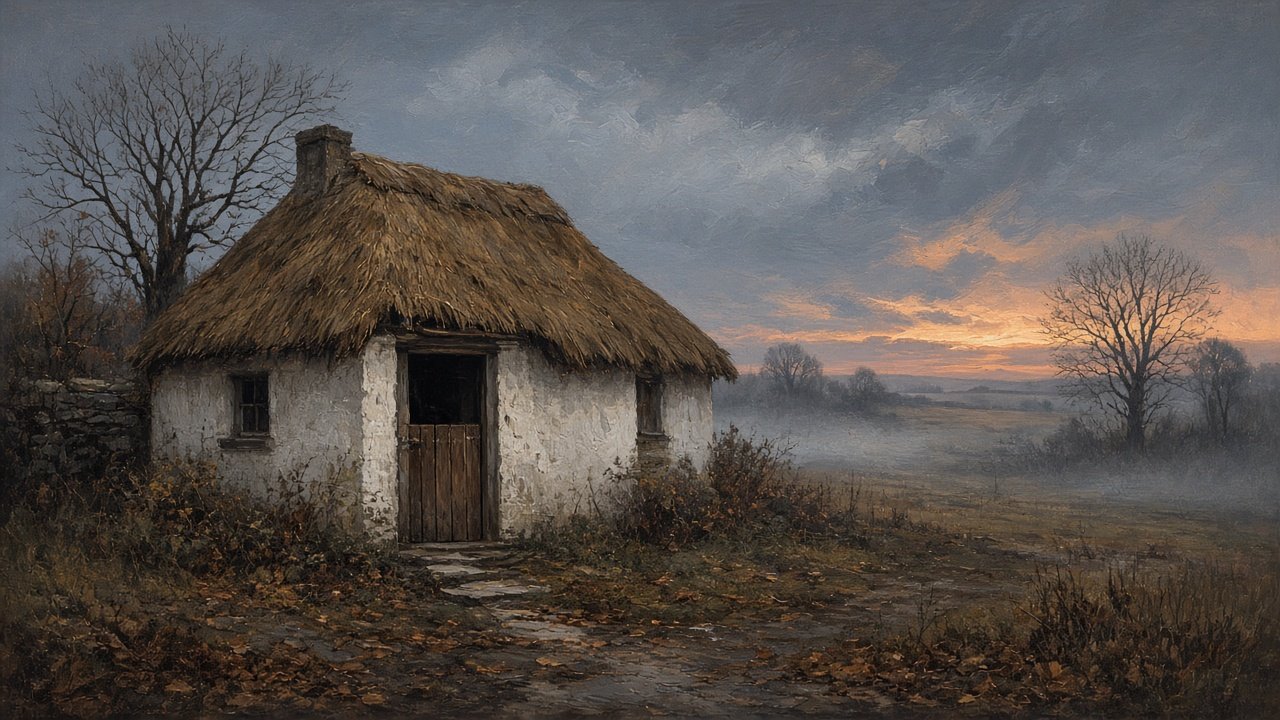
There is a custom from the Irish countryside that tends to stop people in their tracks when they first hear of it. On the night of 10 November, St Martin’s Eve, the head of the house would take a cock, a hen or a goose from the yard, kill it, and let its blood fall on the threshold, the doorposts and the four corners of the kitchen. Then the bird was cooked and the family sat down to eat it.
This was not some half-remembered rite from the distant past. Children wrote it down as a living custom in their school copybooks in the 1930s, and folklore collectors were still recording first-hand memories of it within the last couple of decades. With Martinmas falling on Wednesday this week, it is a good moment to look at one of the strangest and most widespread customs of the rural Irish year.
Who was St Martin?
Martin of Tours was not an Irish saint, but he was a much-loved one here. According to Vatican News, he was born around the year 316 in Pannonia, in what is now Hungary, the son of a Roman military tribune, and was made to enlist as a soldier. The story everyone knows comes from that time: meeting a half-naked beggar at the gates of Amiens, Martin cut his military cloak in two with his sword and gave half away. That night, the story goes, he dreamed of Christ wearing it.
He later left the army, founded monastic communities in Gaul and was chosen Bishop of Tours in 371. Britannica records that he died on 8 November 397 at Candes, and that his feast is kept in the West on 11 November. All over Europe the day is still marked, with geese, new wine, lanterns and processions in Germany, the Netherlands and elsewhere. In Ireland it took a different and darker turn.
“Spilling blood for St Martin”
The custom went by various names, most often “spilling blood” or “shedding blood” for St Martin. The details changed from parish to parish, which is exactly what you would expect of a tradition handed down by word of mouth rather than written rules.
In 1937 and 1938, schoolchildren all over the country gathered local lore from their parents and neighbours for the Irish Folklore Commission. That work, now known as the Schools’ Collection and digitised on dúchas.ie, holds well over a hundred entries filed under the Feast of St Martin. Read a handful of them and the pattern is clear: a bird is killed, its blood goes on the house, and it brings luck or keeps harm away for the year ahead.
Offaly is well represented. At Clonmacnoise school, a pupil wrote that “on St Martin’s Day the people used to kill a cock, and sprinkle the blood on the door-step for luck.” At the convent school in Ferbane, it was the barn door: “a cock is killed and the blood of it sprinkled on the barn-door to keep away sickness during the year.” In Mucklagh, near Tullamore, the people “used to kill foul for the dinner, such as a goose or three chickens. They made crosses on the backs of the doors with the blood of the fowl.”
The most memorable line comes from Cadamstown, near Kinnitty, on the slopes of the Slieve Blooms. There, a cock was killed on St Martin’s night and its blood thrown out in the yard, “as it is said, if you don’t kill for St Martin he will kill for himself.”
Further west, a Mercy convent pupil in Tuam, Co. Galway, recorded that the blood was sprinkled “in the four corners of the kitchen”, sometimes as a cross or three drops, and that it was believed “no member of the family will meet with a violent death during the year.” She also noted that the killing was done in the week before the feast, not on the day itself, and gave the old proverb behind it: Glacann Máirtín roimhe ach ní ghlacann sé ina dhiaidh, “Martin accepts before [his feast], but not after.”
An adult questionnaire gathered by the Irish Folklore Commission around 1940 adds a striking detail. In one account, the woman of the house killed the cock at the back door so that the blood fell on the threshold, saying “For God and St Martin” while the bird died. The blood was left “till it is worn away by time.”
How old is it, and where did it come from?
According to an RTÉ Brainstorm article on Martinmas, the custom was strongest from north Connacht down to Kerry and across the midlands, and rarer in Ulster and on the east coast. The same piece notes that the folklorist Kevin Danaher, in The Year in Ireland, traced the St Martin’s Day blood-letting back to at least 1500. It also quotes the scholar Henry Morris, writing in the journal Béaloideas, who found little connecting the saint himself with the practice and concluded that it was “originally a pagan ceremony that had been observed annually about the second week of November, and was transferred under early Christian influences to St. Martin’s Day.”
People in the 1930s had their own explanations, and they varied. Some said Martin had been martyred and his blood scattered. Others said he had been torn by briars crossing a wood and lost all his blood. None of these stories match the historical bishop of Tours, who died of a fever as an old man, but they show how a community explained a custom it had inherited.
There was also a practical side. The RTÉ piece points out that mid-November was the natural time to kill surplus animals that could not be fed through the winter. The blood was not wasted either: a cloth dipped in it was sometimes kept in the rafters as a cure to stop bleeding. In some places, better-off farmers shared meat with poorer neighbours so they could have a feast too.
The day no wheel would turn
The second great rule of Martinmas was that no wheel should turn. Mills stood idle, spinning wheels were put aside, and in some districts nobody would yoke a horse to a cart. The reason given almost everywhere was that St Martin had been killed by a mill wheel. The Clonmacnoise pupil put it plainly: “St Martin was ground in a mill. No mill grinds on St Martin’s Day.”
Sligo Heritage tells a story from Ballisodare, where the workmen at the Pollexfen flour mills refused to work on 11 November. The owners insisted the mill run as usual, and, so the story goes, it burned down that night. From then on, the day was kept as a holiday. A Wexford folklore collector writing for RTÉ Culture recorded a similar memory from a miller’s son in Kilmuckridge, whose father never ran the mill on St Martin’s Day.
Old Hallowe’en
In parts of the midlands, Martinmas was also called “Old Hallow Eve”. The Clonmacnoise schoolchildren noted that “some of the old people have their Hallow Eve customs on this day.” The likely reason is the calendar. When Ireland and Britain moved from the Julian to the Gregorian calendar in the eighteenth century, days were dropped, and some country people kept their feasts by the old reckoning. That put the old 31 October close to St Martin’s Eve. If you read our piece on Samhain, the old Irish new year, you will see how much of the dark half of the year’s folklore clusters around these few weeks.
Martinmas now
Few people kill a cock on their back step these days, and the mills that once fell silent on 11 November are mostly gone. But plenty of older people in rural Ireland can still remember a parent or grandparent doing it, and RTÉ’s Wexford contributor recorded a Mayo woman in 2008 who could still recall, with a shiver, her father marking the children’s foreheads with the blood.
It is worth asking the older people in your own family or parish about it this week, while those memories are still there to be gathered. The schoolchildren of 1937 did exactly that, and that is the only reason we know any of this today.
Do you remember Martinmas customs in your own family or townland? Or do you write poetry, prose or short stories, or take photographs of rural Ireland? We’d love to hear from you. Send us your work.